C H R I S T M A S . P A R T Y!!

To end our year in Grade Two we decided to immerse the children into a math inquiry project - PLAN YOUR CHRISTMAS PARTY!

The children were told that they had to plan the entire party all on their own with an excursion to our local Coles and with a BUDGET for food and decorations! "A budget? What is a budget?" the children questioned! Hehe!

This inquiry/math based project has given the students an opportunity to build real life problem solving skills such as brainstorming ideas, identifying problems and solutions, developing organisation, collaboration, researching and decision making skills!


Using iPads the children used the Coles website to identify what food, drinks and decorations they may need or want. The children had to classify the items they selected into groups.


The children have applied their math knowledge of surveying, collecting, presenting and interpreting data to select items to purchase. They were adding, multiplying and dividing to calculate the quantity of items needed. Once this was achieved, the children began adding and multiplying money to calculate the cost of items and then had to cross check this with their budget! This was a great experience for the children as they went WAY OVER BUDGET! "What does this mean Miss McVeigh?", "Why can't you just give us more money?" hehe! The children had to make hard decisions about what to cut from their shopping lists. The children used their imagination and creative skills to make decorations and games to save money! They made their own Christmas tree and a 'Pin the Nose on Rudolph' game!


Once all the party planning was accomplished the children were ready to go SHOPPING! We used Google Maps to identify the best and safest route to get to our destination as we decided to walk to save costs on buses. Each group had their own bag of money which they had to calculate how much change needed to be given back after their purchases. Each student brought their own recyclable/reusable bag to minimise plastic pollution as our part of our Religion unit we have been learning about being PLANET PROTECTORS!


On the day of the party the children set up the tables and decorated the classroom. They shared food, played Christmas games and danced to Christmas music!


This has been the HIGHLIGHT of the year with and a HUGE amount of learning! Such a success!


Socratic Seminars - Philosophers in the Making!

I have just recently introduced my Grade 3’s to the strategy of Socratic Seminars. The word “Socratic” comes from the name Socrates, a Classical Greek philosopher who developed a Theory of Knowledge. 

The Socratic Seminar is a discussion, based on a text or topic, in which the leader asks open-ended questions.  Within the context of the discussion, students listen closely to the comments of others, thinking critically for themselves, and articulate their own thoughts and their responses to the thoughts of others. They learn to work cooperatively and to question intelligently and civilly.

It is important that the students understand the purpose of a Socratic Seminar is to discuss not debate. By establishing student expectations, rules, positive language and how to assess the effectiveness of the students who participate then students understand the role of everyone involved. With that in mind, teachers should ensure they allow time to prepare their students before engaging in any socratic circles. 

My students have been learning how to write persuasive texts. I invited them to choose to write about a topic that interests them. After a vote, the children decided on, ‘Should Teachers Give Homework?’ Yes I know, you can imagine how passionate they are about this topic.
I saw this as an opportunity for my students to engage in a Socratic Seminar to discuss the different perspectives around the topic and enable them to form a strong opinion on where they stand in term of whether teachers should give homework.

I played my students a clip from a Channel 9 News report in Perth:
https://safeshare.tv/x/ss59016cc74cc88 (please follow the link to view)


I then distributed a worksheet with open-ended questions that enable students to develop higher-order thinking skills.

These are the questions I provided:

  • Do you agree that homework creates ‘stress’?
  • Would you recommend ‘projects and problem solving’ activities over ‘drills and worksheets’?
  • What is the value of banning homework on the weekend and holidays?
  • Would it be better if children were taught to manage their time better to fit homework in?
  • How many hours a week do you think students should be doing homework?
  • What are the benefits and implications of using computers, iPads and other ICT tools when completing homework?
  • Do you approve or disapprove of the recommendation of no more than 2-3 extra curricular activities per week?
  • Can you propose an alternative to homework?
  • What conclusions can you draw from watching this news report?
  • What is your opinion on whether teachers should give homework?

I gave my students time to independently think and reflect on these questions and jot down any ideas or thoughts they wish to discuss. 

I then selected 10 students to participate in the ‘inside’ circle of the socratic seminar who will be the ones discussing the topic questions. The remaining students were assigned a student to observe in the ‘inside’ circle and were required to record their observations on the effectiveness of that student’s ability to engage in the discussion. 

Peer assessment encourages student engagement, reflection and responsibility for their learning. 

The students that are observing their peers sit behind them in the ‘outside’ circle. Within the ‘inside’ circle there is a special spot called the ‘Hot Seat’. Yep that’s right the HOT SEAT, sounds intriguing I know! The Hot Seat is available for students sitting in the ‘outside’ circle to come and voice a ‘burning’ question or pressing point to those in the discussion. Once the student has shared their thinking or question they then go back to peer observations. 

The peer observations include watching for things such as:
  • Does the student makes eye contact with others?
  • How many times does the student engage in the discussion?
  • Does the student interrupt other speakers?
  • How many times does the student respond to the thoughts and questions of others?

My Grade 3’s loved discussing the topic of homework and had some interesting perspectives on the positive and negative impact homework has on students. They were amazing at providing real and relevant examples and justifying their thinking! 
I believe that by providing students with the opportunity to engage in a socratic seminar around their persuasive piece topic enabled them to recognise the varying perspectives on homework and form a strong opinion on the subject. My students produced some outstanding persuasive pieces on the topic, ‘Should Teachers Give Homework?’.

Here are two student examples with opposing views:


Majority of my students believe that teachers should give homework. They were very specific that the homework should be project based and involve the children playing sports and being outdoors! They all value time spent with their families and do not want homework to get in the way of that. If you ask me I think they made some very reasonable arguments! Well done super stars!!

So what is your opinion...should teachers give homework?

All About Me Project!


I have had so much fun getting to know my students better through their ‘All About Me’ projects. Two weeks ago, I assigned my students their first homework task to create a project that enables their peers and teacher to learn more about them. 

You can grab a free copy of the homework sheet that I gave my students if you would like to try it in your classroom. 

I was blown away by the projects that were presented. All so different and unique. They were all proud as punch when presenting their masterpieces. It was a great way for the students to discover common interests, share their talents and strengthen peer relationships. As a teacher, it was the perfect way to get to know every individual on a personal level. It is important for the children to feel special and valued and by taking an interest in the things that mean the most to them really shows them how much you care. 


A great way to start the year!


Organisation is key!


Wow I can't believe we are in March already! 
First term always flies by so quickly! With testing, getting to know your new students, getting your head around new timetables and analysing data, first term can feel like a crazy roller coaster ride!

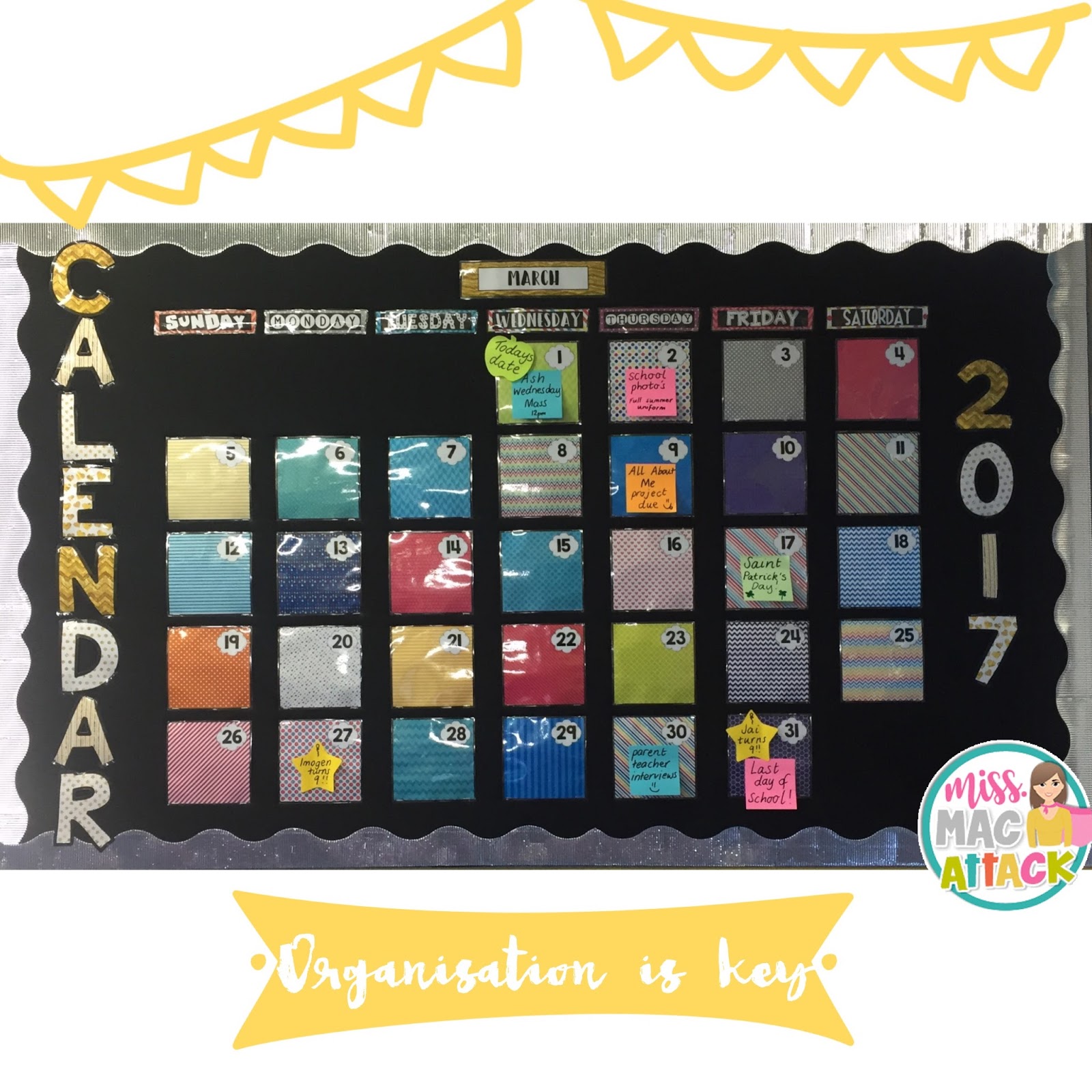
Being organised is the key to surviving as a teacher, so using my phone calendar is an essential part of my planning routine. Last year when teaching my students about calendars it became apparent that they had little knowledge about calendars and how to utilise them. ALARM BELLS! It made me wonder... with all of our lives wrapped up in our phones and technology are children lacking exposure to things such as calendars, maps, getting hands on with money and more. 

I decided that I was going to create a large class calendar to help my students better understand the concept of time, how to utilise a calendar and essentially build on their organisational skills!

My students are loving the giant calendar in the room, labelling upcoming events and counting down the days until the Easter holidays (or is that just me? haha). As a warm up math lesson, I had my students help me change the calendar over from February to March. The students and I were able to engage in great discussions around the days in each month and state facts about what they had observed in regards to days and dates. They loved placing upcoming events in March onto the calendar and having an understanding of the concept of time. 

Designing the calendar, laminating and cutting and changing it over each month does take time...but it's so worth it if my students are building on their knowledge of calendars and organisational skills!

~ ORGANISATION IS KEY ~


New Year, New Beginnings...2017 with Me and My Grade 3's!

IT'S THAT TIME AGAIN!

2017 ~ A New School Year! 
True to my form I am overwhelmed with nerves and jitters at the thought of beginning another school year! You would think these feelings would fade after 4 years of teaching under my belt, but they don't. I know I am not alone when experiencing a restless sleep the night before the first day back at school. Many of my colleagues have expressed these feelings to me before. I guess being passionate about what we do and caring about our students so much is bound to bring out all kinds of feelings.

I am overwhelmed with thoughts and emotions. First of all after an amazing and relaxing 6 weeks off, I have forgotten what full time work is and the thought of working again seems foreign to me right now haha! 
But the other is the excitement of getting a new bunch of amazing individuals and joining them on their learning journey. This year I have 27 students - 7 of which I previously taught when they were in Grade Prep and 20 of whom I have met along the way out on the school yard. I am eager to see how they have grown and changed. The first few weeks are about establishing bonds and relationships. I want to know what these children hope and dream for, what challenges them and what makes them special. I want our classroom to become a little family that trusts and supports one another as we succeed, make mistakes and take risks with our learning.

I am keeping my favourite quote close to my heart as I begin 2017 with my Grade Three students. 

~ They may not remember what you said, but they will always remember how you made them feel ~

Please read my 'INSPIRATION' page to find out more about why this quote inspires me as a teacher!

Wishing you all positive vibes, fun and success in 2017!


HAPPY TEACHING!

Love, Miss Mac 
xo